
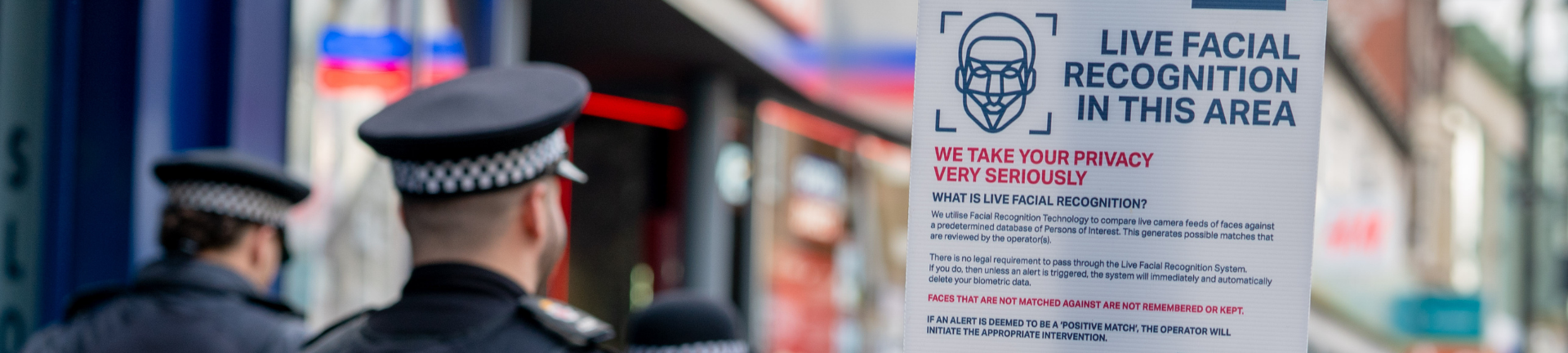
Live Facial Recognition
Surrey Police and Sussex Police have been successful in our joint bid to obtain two live facial recognition (LFR) vans from the Home Office and after extensive planning, these are now live.
The LFR vans are a vital tool in helping us to protect communities, catch criminals and deliver an outstanding service.
Live facial recognition technology is a real-time deployment comparing a live camera feed of faces against a pre-determined watchlist. This will include wanted people like sex offenders and perpetrators of domestic abuse.
LFR vans and their overt deployment can be used in several ways to detect crime, deter and find wanted criminals, and protect people from harm.
In line with legal requirements, the vans will be clearly signposted when deployed and deployment locations will be publicised on our website in advance.
Images of people who are not on the pre-determined watchlist will be instantly deleted forever from the system, thereby minimalizing impact on their human rights.
It is our responsibility to use every tactic and innovation available to us to keep the public safe, deter criminality, protect people from harm and locate the most serious of offenders - and the LFR vans will help us to do exactly that.
Future deployments
- Saturday 17 October - Staines Railway Station
- Sunday 18 October - Staines Railway Station
- Saturday 24 October - Staines Railway Station
- Sunday 25 October - Staines Railway Station
- Friday 30 October - Staines Railway Station
- Saturday 31 October - Staines Railway Station
Most recent deployments
- Thursday 8 October - Stoneleigh
Feedback
Please take a few moments to complete this survey about the use of Live Facial Recognition (LFR) technology in Surrey. Your feedback is valuable and will help us understand public perception of this technology and its use.
Frequently Asked Questions
Biometric data storage
If anyone walks past the vans and is not identified as being on the watchlist, their faces will be automatically blurred on the live camera feed. Any facial data will be immediately and permanently deleted in less than 0.2 of a second. It will not be stored or retained in any of our systems or databases.
In addition, Surrey Police and Sussex Police will delete all alerts immediately after using them or within 24 hrs. The CCTV footage used by the technology, is recorded, and then deleted within 24 hours. If there is an incorrect alert, the information and image will be deleted straight away.
Predetermined watchlists
This is a list for deployments which contain details of people who are wanted for crimes, subject to court orders or pose a risk to the public. Unless you are on the watchlist you cannot be matched. When the technology finds a possible match, an alert is generated.
Data deletion
This relates to biometric data so for people who don’t cause an alert. This biometric data will be automatically and immediately deleted. For those images that do cause an alert, these are deleted within 24 hours.
Privacy rights
The use of live facial recognition technology by Surrey Police and Sussex Police is designed to be responsible, proportionate, and fair. It aims to keep the public safe, identifying serious offenders and protecting the vulnerable. Surrey Police and Sussex Police uses transparency that demonstrates effectiveness, proportionality and compliance with legislation and guidelines when deploying live facial recognition technology.
Third-party agencies
We will never pass biometric data to third-party, non-law enforcement agencies.
Compilation of watchlist
Each deployment will have an individual watchlist created for it. This list will include people who are wanted by us for a variety of serious offences and who have not yet been located.
Watchlist sharing
We may share LFR watchlists with other UK police forces where a specific, necessary and proportionate requirement is identified, such as for Public Order / Public Safety events. Whilst we are responsible for the generation of the watchlist, each recipient force retains accountability for its deployment and engagement with the public. Watchlists are custom-generated for specific operational purposes and are to be used in accordance with the recipient’s relevant legislation, policies and information governance requirements.
Public order / Public safety events
The use of LFR at public order and public safety events will be considered in the context of the overall operation; and LFR is one of the tactics available to commanders depending on the threat, risk and harm identified.
Will people aged under 18 be included in watchlists?
Our watchlists contain details of persons who are sought as wanted or suspect of active crime investigations, which includes some people who are aged under 18.
We are still carefully considering the criteria for deploying this technology, and may in the future also use it to help find high-risk missing children or those who are at risk of exploitation.
What testing has been done on the technology to ensure it is accurate?
The Home Office commissioned comprehensive testing of the technology (NEC Software) which was completed by the National Physical Laboratory. View the report.
What happens to the moving images of those walking past the van who aren’t on the watchlist?
The technology includes a privacy feature to automatically blur or obfuscate faces of people in the background who are not on the watchlist, protecting their privacy while focusing on known individuals or watchlisted subjects. They will then be deleted immediately and forever.
How will we know when the deployments are going to be?
They will be proactively published on our website with a minimum of seven days notice.
What happens in the case of an incorrect alert?
If a match is made by the technology, it will always be corroborated by an officer to check it is the right person, before engaging with that person in an appropriate manner.
How will the use of this technology be regulated?
LFR use by law enforcement is regulated by common law and statutes such as the Police and Criminal Evidence Act (PACE) 1984, the Human Rights Act 1998, Equality Act 2010, the UK General Data Protection Regulation and the Data Protection Act 2018.
It will also be locally regulated by the requirement to undertake an equality impact assessment before deployment, and deployments will be subject to on-going oversight and scrutiny.
Is there an ethnicity or gender bias?
Historically we know that there have been issues with facial recognition technology and a potential gender and ethnic bias. However, as the technology has developed this has greatly reduced and the national algorithm we will be using shows no statistical bias (as tested nationally). However, we have also committed to briefing officers before each deployment regarding the potential disparity to colour, age and gender, and will ensure there is extra corroboration before any action or engagement is taken.
Who authorises the deployments?
Only senior police officers / superintendents and above, will be able to authorise a deployment of the live facial recognition vans.
How will you decide where deployments take place?
No specific areas have been pre-identified for a deployment and locations will be decided based on crime data, hotspots of criminal behaviour and potentially as part of a wider operation. This will be carefully considered by the authorising superintendent prior to the decision.
What is classed as a 'wider operation' when authorising an LFR deployment?
A 'wider operation' would be a separate operation that the LFR van could be deployed as part of. This may be a LFR van being deployed during a public order operation, a football operation or a music event that is planned for a separate purpose but for which LFR brings additional benefits.
What happens if a person wears a face covering when walking past the van?
Unless there are specific powers in place in the area where the van is deployed i.e. a S60 authority, then we are not able to require a person to remove a face covering. As is our policy, if a section 60 authority is granted, we proactively publish this information on our external channels.
How many officers are deployed as part of an LFR operation?
This will vary for each deployment and as is standard with operational information like this, it is not disclosable.
LFR Deployment Returns
| Deployment Location | Date | Start | End | No. on Watchlist | Total Alerts | True Alerts (confirmed) | True Alerts (unconfirmed) | False Alerts (confirmed) | False Alerts (unconfirmed) | False Alert Rate | Arrests & Disposals directly attributed to an LFR alert | Arrests & Disposals not directly attributed to an LFR alert but from the deployment* | Faces Seen |
| Redhill Town Centre | 23/01/2026 | 11:24 | 15:48 | 7,706 | 4 | 4 | 0 | 0 | 0 | 0.00% | 1 Arrest (s4 POA and CPW issued), 1 x subject with Court Order processed | 0 | 16,904 |
| Staines Town Centre | 28/01/2026 | 14:47 | 19:00 | 7,517 | 1 | 1 | 0 | 0 | 0 | 0.00% | 1 x subject with Court Order processed | 1 x Community Resolution (Drugs) | 16,287 |
| Camberley Town Centre | 30/01/2026 | 10:36 | 15:00 | 7,497 | 0 | 0 | 0 | 0 | 0 | 0.00% | 0 | 0 | 12,145 |
| Ashford Town Centre | 17/02/2026 | 11:15 | 14:41 | 8,075 | 1 | 1 | 0 | 0 | 0 | 0.00% | 1 x Arrest (Theft) | 1 x Arrest (Theft) | 2,268 |
| Epsom Town Centre | 12/03/2026 | 11:28 | 13:45 | 7,821 | 0 | 0 | 0 | 0 | 0 | 0.00% | 0 | 1 x Community Resolution (Drugs) | 16,058 |
| Woking Town Centre | 07/04/2026 | 12:27 | 15:56 | 7,870 | 4 | 3 | 1 | 0 | 0 | 0.00% | 2 x subjects with Court Orders processed, 1 x Voluntary Attendance Interview (Theft) | 1 x Arrest (EMS breach), 1 X Community Resolution (Drugs), 1 x e-scooter seized | 22,122 |
| Guildford Town Centre | 17/04/2026 | 10:27 | 14:57 | 7,891 | 1 | 1 | 0 | 0 | 0 | 0.00% | 1 x subject with Court Order processed | 0 | 11,643 |
| Epsom Town Centre | 30/04/2026 | 15:53 | 20:30 | 7,899 | 2 | 2 | 0 | 0 | 0 | 0.00% | 2 x Voluntary Attendance Interviews (Harassment) | 1 x Arrest (Immigration issue), 2 x Community Resolutions (Drugs) | 9,327 |
| Guildford Town Centre | 09/05/2026 | 10:09 | 15:00 | 7,965 | 2 | 2 | 0 | 0 | 0 | 0.00% | 0 | 0 | 5,951 |
| Woking Town Centre | 28/05/2026 | 11:46 | 15:30 | 8,041 | 8 | 8 | 0 | 0 | 0 | 0.00% | 2 x subjects with Court Orders processed, 1 x suspect eliminated from enquiries | 0 | 31,580 |
| Guildford Town Centre | 29/05/2026 | 10:28 | 15:02 | 8,052 | 2 | 2 | 0 | 0 | 0 | 0.00% | 2 x subjects with Court Orders processed | 0 | 18,738 |
| Redhill Town Centre | 03/06/2026 | 10:10 | 13:30 | 8,122 | 0 | 0 | 0 | 0 | 0 | 0.00% | 0 | 1 x arrest (Theft), 1 x arrest (Drug Driving) | 6,396 |
| Staines Town Centre | 23/06/2026 | 12:41 | 15:48 | 7,813 | 0 | 0 | 0 | 0 | 0 | 0.00% | 0 | 0 | 2,920 |
| Guildford Town Centre | 04/07/2026 | 10:43 | 15:12 | 8,240 | 1 | 1 | 0 | 0 | 0 | 0.00% | 1 x suspect confirmed as being processed previous day | 0 | 24,427 |
| Walton Town Centre | 30/07/2026 | 10:45 | 14:00 | 8,152 | 0 | 0 | 0 | 0 | 0 | 0.00% | 0 | 1 x arrest (bulk shoplifting), 1 x e-scooter seized | 5,988 |
| Caterham Town Centre | 31/07/2026 | 10:20 | 15:40 | 8,194 | 0 | 0 | 0 | 0 | 0 | 0.00% | 0 | 1 x arrest (recall to prison) | 17,261 |
| Redhill Town Centre | 25/09/2026 | 15:30 | 18:45 | 8,255 | 2 | 2 | 0 | 0 | 0 | 0.00% | 1 x Arrest (Attempt Burglary) | 1 x arrest (Indecent Exposure), 1 x Voluntary Attendance Interview arranged (Theft-Shoplifting) | 3,137 |
*Activity generated by the Engagement Team officers while deployed on the ground, but not as a direct result of an LFR alert
| DEPLOYMENT LOCATION | DATE | START | END | NO. ON WATCHLIST | TOTAL ALERTS | TRUE ALERTS (CONFIRMED) | TRUE ALERTS (UNCONFIRMED) | FALSE ALERTS (CONFIRMED) | FALSE ALERTS (UNCONFIRMED) | FALSE ALERTS RATE | ARRESTS & DISPOSALS DIRECTLY ATTRIBUTED TO AN LFR ALERT | ARRESTS & DISPOSALS NOT DIRECTLY ATTRIBUTED TO AN LFR ALERT BUT FROM THE DEPLOYMENT* | FACES SEEN |
| Redhill Town Centre | 13/11/2025 | 10:40 | 15:00 | 8,124 | 5 | 5 | 0 | 0 | 0 | 0.00% | 2 Arrests (1 x RSO breaching conditions & 1 x Theft/s4 POA), 1 x subject with Court Order processed | 0 | 8,546 |
| Woking Town Centre | 26/11/2025 | 10:43 | 15:10 | 7,686 | 0 | 0 | 0 | 0 | 0 | 0.00% | 0 | 1 Arrest (Rape & Theft), 4 x Community Resolutions (Theft) | 8,851 |
| Epsom Town Centre | 02/12/2025 | 11:15 | 15:45 | 7,670 | 0 | 0 | 0 | 0 | 0 | 0.00% | 0 | 1 Arrest (Theft & Fraud) | 5,337 |
| Guildford Town Centre | 13/12/2025 | 10:44 | 16:13 | 7,764 | 4 | 4 | 0 | 0 | 0 | 0.00% | 1 x Arrest (Assault of child), 2 x subjects with Court Orders processed | 1 x Voluntary Attendance Interview (Theft), 1 x Begging Warning issued | 67,642 |
| Walton Town Centre | 16/12/2025 | 10:33 | 15:50 | 7,780 | 2 | 2 | 0 | 0 | 0 | 0.00% | 1 x Voluntary Attendance Interview (Theft) | 0 | 7,129 |
* Activity generated by the Engagement Team officers while deployed on the ground, but not as a direct result of an LFR alert
Downloads